Audio Technology Review: Violet Audio dMix128
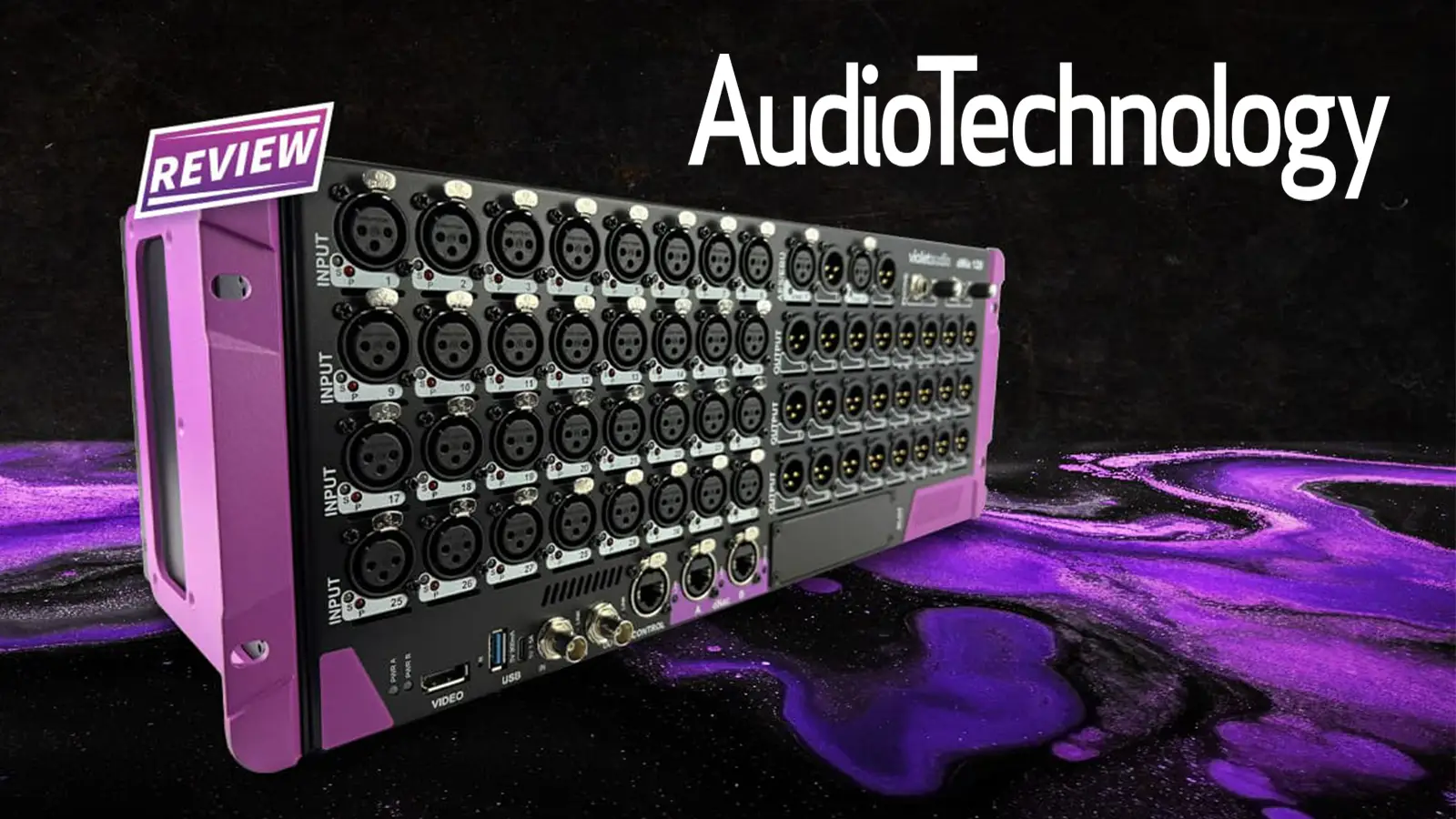
The Violet Audio dMix128 is an evolving audio control ecosystem that is both a high performance 128-channel digital audio mixer and a powerful networked audio matrix.
Sounds complicated but this is very cool breakthrough product.
As an audio mixer it offers the highest sound quality, near unlimited processing and control from most any online device. As an audio matrix it can solve problems and create possibilities in a wide range of applications – from venues to radio, broadcast and studio settings, large scale installations, corporate or educational facilities.
Violet Audio is led by Melbourne-based live sound mix engineer and electronic designer, Danny Olesh. His background includes establishing the SM Pro Audio brand of audio products, together with John Fuller his long-time business partner, developing Dolby/DTS processors and creating digital patch bays. What’s more, technologies the team developed with long-term collaborators, digital audio network specialists DSPRO from Brazil and DSP/firmware developer George Yohng, are used in Soundcraft, dbx and AKG products, including the Soundcraft Ui range of digital mixers and Waves products.
The Violet Audio dMix128 is an ambitious project that combines their years of expertise and experience in digital audio. The result feels like a clean-slate design utilising the latest technologies to deliver a wish list of digital audio functionality, with extensive networking, in a package that is practical, flexible and futureproof.
RACK RATE
From the outside the dMix128 is a 4U rack-mountable box o’ sockets finished in black with signature violet accents. The matching ‘durable rack mounts’ are a nice touch, they can be mounted flush or sunken back in the rack for neatness, or a place for the cables when travelling. They can also be mounted front or rear facing.
Making full use of the space, the front panel has 32-in/24-out analogue XLR sockets, 2 x AES/EBU I/O, 2 x RJ45 dNet (AES67) ports, an RJ45 control port, MADI I/O coaxial, USB-A and -C, and a DP display port. Plus, two headphone sockets with volume knobs, and an empty expansion slot ready for whatever new interface protocol may emerge. On the rear you’ll find two IEC 240V sockets for the dual redundant power supplies with locking devices.
BEAUTIFUL ON THE INSIDE
The magic is inside. The core architecture uses the latest FPGA parallel, deterministic processing that allows for low, fixed latency, no matter how much processing/mixing is being done. You get 128 channels (with full processing) that can be mixed into 88 busses (with full processing) at 96kHz with no shared resource limitations. Analogue-to-analogue latency is always less than 0.3ms.
New mic preamps contribute to the outstanding technical performance: audio specs of 115dB dynamic range, 0.001%THD and -128dBu EIN. Frequency response is quoted at ±0.1dB (20-40kHz, 96kHz sampling), phase shift less than 10° at 20kHz.
And you can hear it. The dMix128 left a strong impression on a first listen and I’m still enjoying it. Almost dark, but with natural, smooth higher frequencies and effortless transients, it’s not at all tizzy, grainy, brittle or scratchy. The raw sound is transparent across the mid-range with full low frequencies that keep reminding me of the LF on my Midas analogue mixer. That’s the only analogue comparison, the processing power available here is way beyond anything from that old world and the dMix128 is loaded. Each channel has a full suite of processors that can be freely re-arranged and each processor has a complete, and often enticing, selection of control options.
NEED TO KNOW
Violet Audio dMix128
Digital Audio Mixer/Matrix
PRICE
A$8995 RRP
US$5995
CONTACT
Violet Audio: violetaudio.com
PROS
Exceptional audio fidelity
Fixed ultra-low latency (<0.3ms analogue-to-analogue)
128 channels into 88 fully processed busses at 96k
Highly flexible, rearrangeable channel processing
Extremely powerful 128×128 digital matrix
Comprehensive networking
True headless HTML5 browser control
Strong integration options plus multi-user access
On-board AI/MCP server for spoken commands and automation
Compact 4U form factor with dual redundant PSUs
CONS
GUI still evolving (early-days feel)
Currently headless – control surfaces and stageboxes still in development
Mute All button easy to trigger accidentally
Deep feature set and matrix mindset require a learning investment
Ecosystem (surfaces, stageboxes, widespread familiarity) still maturing
SUMMARY
The Violet Audio dMix128 is a high-performance 128-channel digital mixer and powerful networked audio matrix in a compact 4U package. Outstanding sound quality, fixed ultra-low latency, massive processing power and an exceptionally flexible matrix make it equally capable as a live console, installation processor or software-defined audio router. HTML5 control, broad AoIP support and emerging AI features give it strong future potential. While the GUI and physical control ecosystem are still developing, the core performance and flexibility are already impressive.
Inputs have the expected gain, 48V and phase, plus fully variable HP and LP filters with selectable slopes (-6, -12, -24dB/octave), and a variable saturator.
There are four types of standard compressor models (Clean, VCA, FET, Opto) or chose from Violet Audio’s DNA22 (faster, cleaner) or the DNA43 (slower, coloured) comps. All come with the option of inserting any channel in the sidechain, with EQ. It would take all the noodling time of a full tour to get to know all their subtleties.
The parametric EQ opens like a normal four-band parametric with a well-placed Q slider. Its first trick is giving you the option to add up to four more EQ bands. Very handy – four is often not enough, while eight is plenty. The second trick is the option of each band becoming a dynamic EQ, with controls, options and sidechain. On every band.
A separate graphic EQ is appreciated – I often use them on outputs. There’s a good de-esser that delivers fine control over where the sibilance is and how it gets treated. A four-band dynamic M-Comp rounds out the processors with some broad dynamic control. An Insert point can be routed from analogue or digital I/O, with four-band dynamic EQ and FX.
The effects reflect Violet Audio’s commitment to audio purity and lateral thinking. The 10 on-board FX slots offer versions of the most used effects. The reverbs are noteworthy for their modelling, which aims to emulate only the depth and width of a space without artifacts or colouration. This is achieved by programming that avoids including the results of theoretical direct collisions between the reflections interacting and decaying in the virtual space. The result is reverbs that are subtle but deep and un-coloured, with smooth tails that mimic the natural HF roll-off over time.
Analogue-to-analogue latency is always less than 0.3ms
ALL THE PROTOCOLS
The FPGA processing supports audio-over-IP protocols including AES67, MADI, SMPTE ST2110-30 with NMOS, and the optional 128×128 Dante interface, without the need for external hardware (NB: you can run Dante without the card over AES67 with Dante Controller). You can connect the dMix128 directly to a Dante or AES67 stagebox network for mic inputs, split them internally or cascade to another dMix for monitors. If a higher channel count is needed, up to four dMix units can be linked together, with sample-accurate synchronization.
For broadcasting applications, MADI or AES67 feeds from cameras and live mics could be mixed and, for example, sent clean to the director, while simultaneously sending streams to a second engineer’s system, with program and ISO tracks available over the network. In hybrid studio/post production settings the native support for ST2110-30/NMOS makes it ready for broadcast-grade IP infrastructures as they expand. Optional Dante keeps it compatible with existing studio gear.
Multi-user access and support for custom protocols make the dMix an ideal solution for fixed installations. A REST API and WebSocket JSON interface provide access for integration with third-party audio networking systems including Q-SYS, Crestron, RTI, AMX and Extron. Native support for ECP, QRC and generic OSC devices enable remote management of most audio parameters, as well as site-automation systems and AV control, without external devices. The matrix nodes can easily send different mixes to separate locations over AES67 or MADI while the web-based GUI means scenes or levels can be changed from any tablet on the building network. Up to 10 devices can access the dMix simultaneously. Cloud monitoring helps ensure reliability.
THINKING AI?
Things get contemporary when you throw AI into the mix. In July 2026 a firmware update added an on-board MCP (Model Context Protocol) server to the dMix. The server runs on any device on the same network and communicates via the native dMix protocols. Any compatible AI app can interact with the dMix and access most functions.
Spoken word instructions are interpreted by the AI and actioned inside the dMix. Thoughts will be enough in the future. Create custom GUIs. Turn PDF channel lists into desk layouts. Creating complex user permission systems to assist and control multiple users and more. Much more.
VIOLET ULTRA
Violet Audio has created a unique product in the dMix. There’s no direct competition and what comes close costs a lot more. I like it as a digital mixer par excellence. The fidelity, processors/effects, channel count, connectivity, combined with the ability to run a big show, or a small-to-medium sized venue, from a 4U portable package, will appeal to a wide variety of users once they see the potential.
Beyond a digital mixer the dMix128 is also a software-defined audio router that encourages integration with existing and future audio control/distribution protocols, making it capable of managing large-scale productions and complex installations. When it becomes even more of a bargain.
The Violet Audio dMix128 is fully functional right now with the promise of more features added over time. Some of them will come based on how users interact with the dMix, while others will come from interfacing with emerging technologies. The range of physical controllers and stageboxes will increase its appeal. Who knows where the AI will lead but it’s fun for now. The dMix128 journey is just getting started.